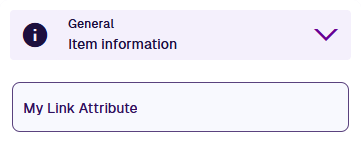
Link attribute
Store links to items
A Link attribute can reference one or more items of a specific design/interface by storing each item's ID, e.g. 6758a550ff1c5166ca70d673.
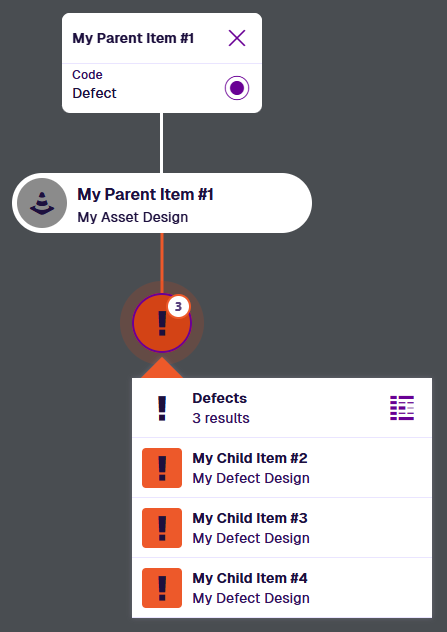
This lets you define relationships between designs/interfaces and link their items together. The item containing the Link attribute is considered the parent and the stored items are its children. You can navigate from a parent item to a child item and vice versa!
For example, this is how assets and defects are linked together. By default, all asset items have a Defects attribute, which can link to items of any design that implements the Defects interface.
Configuration
When adding or editing a Link attribute on a design/interface, you can configure the following properties. These determine how the attribute will behave when users populate its value on corresponding items.
- Code (read-only) - the attribute's Global Unique Code (Guc) identifier.
- Name * - enter a distinct name that clearly identifies the attribute.
- Description - describe what the attribute represents and how it's intended to be used. This helps users and AI agents to understand its purpose.
- Required - if enabled, the attribute must be populated before an item can be saved. It can't be left blank!
- Read-only - if enabled, the attribute can only be populated when creating items. It can't be edited afterwards!
- Unique - if enabled, the attribute only accepts values that aren't already stored in other items of the design/interface.
-
Design or interface * - choose the type of items the attribute can link to. This can be the same design/interface that the attribute is defined on, e.g. all job items contain a Related Jobs attribute that can reference other job items.
-
Graph * - choose the item graph type that linked items will appear on.
- Default value - the attribute is automatically populated with this value. It can usually be changed before saving, unless the attribute is also Read-only or excluded from an item form.
-
Weak link - if disabled, the attribute will become Strong. This means, when an item is removed, any child items referenced by this attribute will also be removed! However, child items may always be cloned, regardless of this property.
-
Max - limit the number of items the attribute can link to.
-
Tags - use the Tag Manager to assign custom tags or a relevant system tag.
Available system tags
Treat the attribute as:
- Image - if the attribute links to an item of the Files design that stores an image, its thumbnail is displayed. If multiple items are linked, the count is shown as usual.
-
RequiredOnTaskStatus[Completed/Cancelled] - only relevant if the design/interface implements the Tasks interface. The attribute becomes required when a task's status changes to Completed or Cancelled.
-
ActionParameter[Dynamic] - for internal use only. Marks the attribute as a configurable parameter on a workflow action.
- AQS agent enabled - if disabled, the attribute is excluded from AI agent queries.
Populate the attribute on items
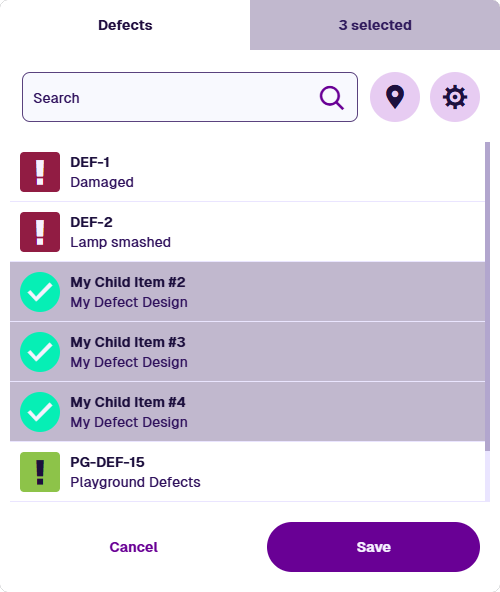
When creating or editing an item, select the attribute to open the item picker. All items of the configured design/interface will be listed. Scroll the list or use the search box to find and select items.
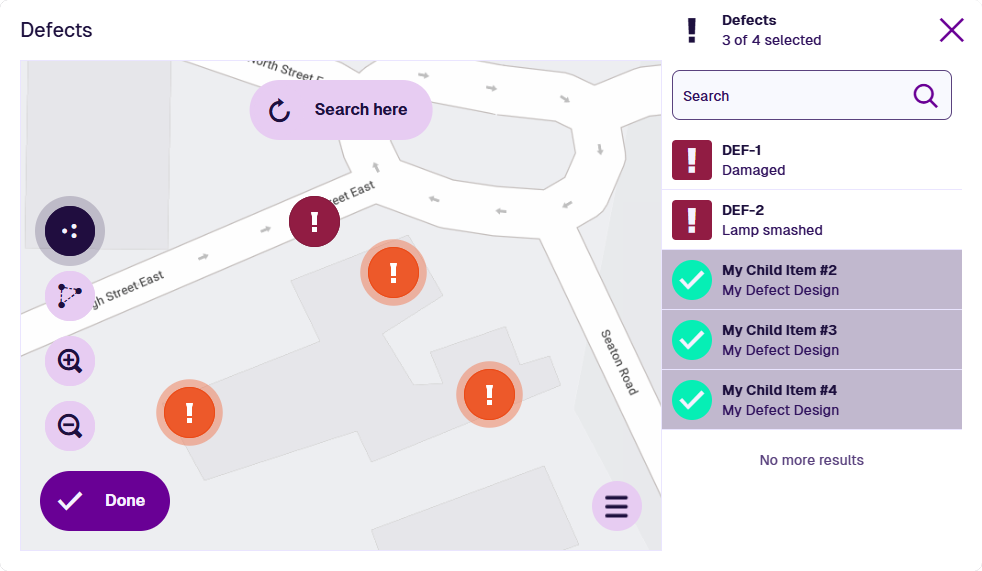
If the items have geometry, you can visualise them on the map. Select Open Map in the item picker to open the map picker. Select items on the map or in the list.