Seasonal attribute
Store a day of the year
A Seasonal attribute can store a date without a year, typically to represent a reoccurring event, e.g. 25th December.
Configuration
When adding or editing a Seasonal attribute on a design/interface, you can configure the following properties. These determine how the attribute will behave when users populate its value on corresponding items.
- Code (read-only) - the attribute's Global Unique Code (Guc) identifier.
- Name * - enter a distinct name that clearly identifies the attribute.
- Description - describe what the attribute represents and how it's intended to be used. This helps users and AI agents to understand its purpose.
- Required - if enabled, the attribute must be populated before an item can be saved. It can't be left blank!
- Read-only - if enabled, the attribute can only be populated when creating items. It can't be edited afterwards!
- Unique - if enabled, the attribute only accepts values that aren't already stored in other items of the design/interface.
- Default value - the attribute is automatically populated with this value. It can usually be changed before saving, unless the attribute is also Read-only or excluded from an item form.
-
Min - the attribute won't accept a value occurring before this day.
-
Max - the attribute won't accept a value occurring after this day.
-
Tags - use the Tag Manager to assign custom tags or a relevant system tag.
Available system tags
-
RequiredOnTaskStatus[Completed/Cancelled] - only relevant if the design/interface implements the Tasks interface. The attribute becomes required when a task's status changes to Completed or Cancelled.
-
ActionParameter[Dynamic] - for internal use only. Marks the attribute as a configurable parameter on a workflow action.
-
- AQS agent enabled - if disabled, the attribute is excluded from AI agent queries.
Populate the attribute on items
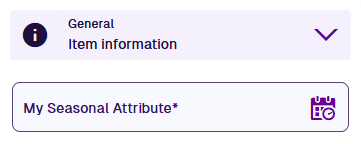
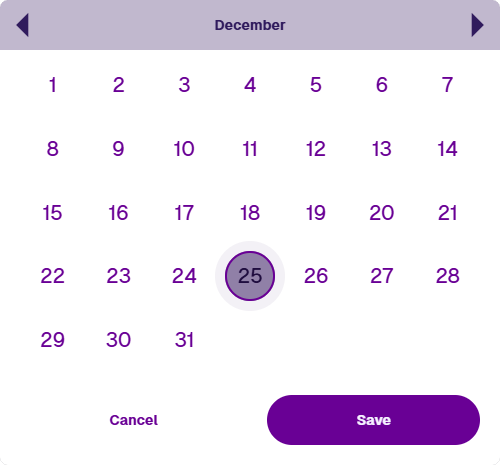
When creating or editing an item, select the attribute open the calendar picker. Use the purple bar to set the month and then select the day.
Setting a Seasonal attribute via the API
To populate a Seasonal attribute via the Alloy API, the value must be supplied in the correct format.
Seasonal Date
When specifying a seasonal date, the value must be supplied in this format:
1972-[month]-[day]T00:00:00
- The year must be set to
1972(because it's a leap year). monthanddayare the required month and day respectively, e.g. 02-11 equals February 11th.- The time must be zeroed out.
Seasonal Time
When specifying a seasonal time, the value must be supplied in this format:
1970-01-01T[hours]:[minutes]:[seconds].[milliseconds]
- The year must be
1970, the month must be01, and the day must be01. hours,minutes,secondsare the required time. These may be zeroed depending on the precision required.millisecondsmay be ignored completely, depending on the precision of the attribute.